

WSC Weekly
2026世界学者杯
the World Scholar's Cup
2026年度主题
Are We There Yet?
WSC Weekly专栏将精选最新话题内容
助力小学者准备世界学者杯!
让我们怀着
永恒的学术精神与信念
探索未来的无限可能吧!
锁定每周WSC Weekly
上期回顾&Quiz答案揭晓
在2026年世界学者杯第25期WSC Weekly栏目中,我们与小学者一起学习了“愿望路径”,探寻了这些由脚印踩出的路线,如何悄悄改变着我们的公共空间。在上期的趣味Quiz中,你是否找到了正确答案?现在就让我们一起来揭晓吧!
点击查看上期话题
世上并没有路,踩草坪的人多了也就成了路?
Desire Paths: The Trails That Reveal How People Really Use a City
第25期Quiz答案揭晓:
Which of the following is not an example of a desire path?
以下哪一项不属于“愿望路径”的例子?
A) Students repeatedly cut across a lawn between two campus buildings, gradually creating a visible dirt trail. 学生们反复穿过两栋校园建筑之间的草坪,逐渐形成了一条明显的土路。
B) Park visitors regularly leave a curved paved path and take a shorter route across the grass, eventually wearing down the vegetation. 公园游客经常离开弯曲的铺砌小径,改走穿过草坪的捷径,最终导致植被被踩踏。
C) Commuters repeatedly walk through the same gap between two parking areas, creating an unofficial route that was never planned by the property owner. 通勤者反复穿过两个停车场之间的同一条空隙,形成了一条业主从未规划过的非正式路线。
D) Residents repeatedly cross an undeveloped piece of land on their way to a bus stop, eventually forming a narrow track that others begin to follow. 居民们在前往公交站的途中反复穿过一块未开发土地,最终形成了一条狭窄的小径,其他人也开始沿着这条小径行走。
E) A city planner studies pedestrian movement before a new plaza opens and builds a diagonal walkway where people are expected to take the shortest route. 一位城市规划师在新广场开放前研究了行人的流动情况,并在预计人们会选择最短路线的地方修建了一条对角人行道。
正确答案: E
Key: E
2026年第26期
Weekly Intro
现在的生活离不开Wi-Fi和无线充电,但在一个多世纪前,特斯拉就已经在尝试让电力“隔空传输”了。本期Weekly带你走近纽约长岛上的沃登克里弗塔,看看这座未完工的巨塔背后,藏着一个怎样超前百年的科技梦。
2026 No.26
建一座塔,能让世界再也不需要电缆?
The Deam Behind Tesla's Wardenclyffe Tower
如果电力也能“隔空传送”?
清晨醒来,你还没下床就先顺手翻看手机里的消息;吃早餐时,音乐从无线音箱中流淌而出;随后,笔记本电脑无需网线便连入了互联网,你或许还会把手机随手放在无线充电板上,省去了插线的繁琐。信息在空气中自由穿梭,早已成为我们习以为常的日常,甚至让人察觉不到它的神奇。但如果把这个设想推向极致呢?倘若电力本身也能摆脱输电线,跨越千山万水随意传输呢?倘若仅仅依靠一座超级发射塔,就能把电报、新闻、音乐、图像乃至源源不断的电能输送到世界各个角落呢?一百多年前,尼古拉·特斯拉(Nikola Tesla)就曾试图将这一宏伟设想变为现实。他当年在纽约长岛的一片原野上立起了一座造型独特的木质巨塔,它被称作沃登克里弗塔(Wardenclyffe Tower),也由此成为了20世纪初最具野心的科技工程核心。
You wake up and check messages on your phone before getting out of bed. At breakfast, music streams through a wireless speaker. Later, your laptop connects to the internet without a cable, and perhaps you place your phone on a charging pad instead of plugging it in. We are so used to sending information through the air that it hardly feels remarkable. Now imagine taking the idea much further.What if electricity itself could travel across great distances without power lines?What if one enormous station could send messages, news, music, pictures, and electrical power around the world? More than a century ago,Nikola Teslatried to build exactly that. His experiment took the form of a strangewooden towerrising above the fields of Long Island, New York. It was calledWardenclyffe Tower, and it became the centerpiece of one of the most ambitious technological projects of the early twentieth century.
沃登克里弗项目

早在1900年,特斯拉就凭借在交流电和高频电领域的开创性工作名扬天下。然而,当时的他已越来越痴迷于无线能量传输。他常常思索:既然电信号无需导线即可传播,为什么应用范围要局限在传递简短的讯息上?1899年,特斯拉暂居科罗拉多斯普林斯(Colorado Springs),在那里建起了一座大型实验室,开展了一系列惊心动魄的高压电实验。他坚信,只要将地球本身与大气层纳入传输系统,就能跨越极其遥远的距离输送电能与信息。回到纽约后,他渴望将这些实验推向更为宏大的工程实践,沃登克里弗项目便应运而生。1901年,该工程在长岛肖勒姆(Shoreham)附近破土动工。特斯拉赢得了金融巨鳄J·P·摩根(J. P. Morgan)的巨额资助,实验室与发射塔则由著名建筑师斯坦福·怀特(Stanford White)操刀设计。整座木塔最终高耸至约187英尺,顶端冠以一个直径约68英尺的巨型金属圆顶。在塔身下方,还隐匿着一套极其复杂的地底深层系统,专门用于配合特斯拉借助大地传导能量的实验。
By 1900, Tesla was already famous for his work with alternating current and high frequency electricity. But he had become increasingly fascinated by wireless transmission. If electrical signals could travel without wires, he wondered, why stop at sending simple messages? In 1899, Tesla moved temporarily to Colorado Springs, where he built a large experimental laboratory and carried out dramatic experiments involving high voltage electricity. He became convinced that electrical energy and information could be transmitted across enormous distances using the Earth and atmosphere as part of the system. When he returned to New York, he wanted to turn those experiments into something much larger. The result was Wardenclyffe. Construction began in 1901 near Shoreham on Long Island. Tesla secured financial backing from powerful banker J. P. Morgan, while renowned architect Stanford White designed the laboratory and tower.The structure eventually rose about 187 feet, topped by a huge metal dome roughly 68 feet across. Beneath it was an elaborate underground system connected to Tesla’s experiments with transmitting energy through the Earth.
不止传信息,还要无线输电!
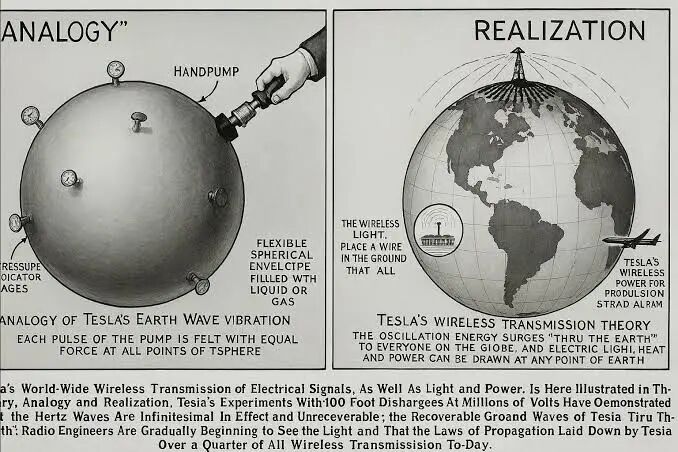
初看之下,沃登克里弗项目就像是无线电报技术的升级版。在当时,这本就是一门炙手可热的先锋领域,古列尔莫·马可尼(Guglielmo Marconi)等发明家正在不断向世人证明,电报讯息完全可以摆脱传统线缆实现远距离传递。然而,特斯拉的胸壑远不止于此,他构想了一套宏大的“世界无线系统”(World Wireless System)。按照他的设想,由发射站组成的全球网络将信息无缝传遍世界,人们只需携带小巧的接收装置,就能随时随地接收新闻、股市行情、音乐、演讲录音、私人信件乃至图像。早在1904年,特斯拉就描绘了这样一幅未来图景:人们带着一台手持设备,无论身处陆地还是大洋,都能即时获取各类讯息。站在如今智能手机与无线网络普及的时代回望,这些构想听起来熟悉得令人惊叹。但特斯拉对沃登克里弗寄予的厚望还不止于此,他更渴望利用同一套网络实现无线输电。这绝非把如今的无线充电底座放大到城市规模那么简单,特斯拉坚信地球本身可以充当全球电力系统的一部分,使得远方的接收终端在没有传统高压输电线的情况下直接获取可用电力。而沃登克里弗塔,正是他用来验证这一庞大系统具备实际可行性的关键据点。
At first, Wardenclyffe could have sounded like an ambitious version of wireless telegraphy. This was already an exciting field. Inventors such as Guglielmo Marconi were demonstrating that messages could be sent across long distances without conventional telegraph wires. Tesla’s plans, however, were much broader. He imagined what he called a World Wireless System. A network of transmitting stations would send information around the globe. People might receive news, stock prices, music, speeches, private messages, and even images through compact receiving devices. In 1904, Tesla described a future in which a person could carry a small device and receive information almost anywhere on land or sea. Seen from the age of smartphones and wireless networks, parts of this vision sound remarkably familiar. But Tesla wanted Wardenclyffe to do something even more extraordinary. He hoped the same system could transmit electrical power without wires. His idea was not simply the modern wireless charging pad enlarged to city size.Tesla believed he could use the Earth itself as part of a global electrical system, allowing distant receiving stations to obtain usable power without conventional transmission lines.Wardenclyffe was supposed to prove that such a system could work on a meaningful scale.
资金断裂与技术壁垒
然而,一个显而易见的现实阻碍横亘在眼前:如此天马行空的超级工程,开销必然是个天文数字。尽管特斯拉起初拿到了J·P·摩根的慷慨投资,但随着工程不断推进,复杂程度与资金消耗都远远超出了预期。摩根看重的是具备商业变现前景的无线通讯,而特斯拉的蓝图却一再膨胀,执意要将其打造成融合全球无线输电的超级工程。随着工期拖延,项目的财务状况每况愈下。与此同时,竞争对手们的步伐却异常迅捷:马可尼成功完成了跨大西洋无线电报通讯实验,这种更为简单聚焦的方案在商业上显得更加切实可行。另一边,特斯拉却还在为了完成沃登克里弗项目四处奔走筹钱。到了1903年前后,资金链的彻底断裂导致工程基本陷入停摆。此后数年间,特斯拉虽竭力奔走试图力挽狂澜,但沃登克里弗塔终究没能成为他梦寐以求的全球无线电中枢。大约到1906年,这个宏伟计划已然名存实亡。需要特别区分的是,虽然特斯拉在实验室里展示过震撼人心的无线电效应,但沃登克里弗从未真正证明电能可以按照他的设想高效率地分配到全球各地。因此,项目的夭折绝非仅仅因为发明家遭遇了撤资,那套系统在走向商业化落地的过程中,所面临的极其严苛的技术天堑在当时根本无力逾越。
There was one obvious difficulty: a project this ambitious was extremely expensive. Tesla had received substantial financial support from J. P. Morgan, but the project grew more complicated and costly than expected. Morgan had been interested in commercially useful wireless communication, while Tesla’s plans expanded toward a much larger global system that also included wireless power. As construction continued, the project's financial position became increasingly difficult. At the same time, competitors were making rapid progress. Marconi successfully demonstrated transatlantic wireless telegraphy, making a simpler approach to wireless communication look increasingly practical. Tesla, meanwhile, still needed more money to complete and develop Wardenclyffe. By 1903, funding problems had largely stopped the project. Tesla struggled for several more years to revive it, but Wardenclyffe never became the functioning global wireless station he had imagined. By around 1906, the project had effectively ended. There is an important distinction here. Tesla had demonstrated impressive wireless electrical effects in experiments,but Wardenclyffe never proved that electrical power could be efficiently distributed around the world in the way he envisioned.Its failure was therefore not simply a story of an inventor being denied enough money. The enormous technical challenge of making the proposed system commercially practical remained unresolved as well.
红砖实验室
此后的漫长岁月里,那座未完工的庞大巨塔孤零零地矗立在长岛的原野上,任由风雨剥蚀。特斯拉深陷债务泥潭,沃登克里弗最终沦为抵债的资产。1917年,巨塔被彻底拆除,拆解下来的材料被当作废铁变卖。这座原本旨在成为全球通信网络先驱的宏伟地标,就此从天际线中彻底抹去。所幸的是,一旁的红砖实验室大楼得以幸存。这一留存显得弥足珍贵,因为它是如今唯一仍然存在、与特斯拉本人直接相关的实验室遗址。在特斯拉离开后的数十年里,该处地产曾被商业机构租用,后来一度闲置荒废,前途未卜。直到2013年,一场由公众发起的保护运动取得成功,该地块被整体收购,后来建成了沃登克里弗特斯拉科学中心(Tesla Science Center at Wardenclyffe)。2018年,该遗址被正式列入美国《国家史迹名录》(National Register of Historic Places)。如今,那座红砖实验室依然静静矗立在原处,而曾经伫立在一旁的参天巨塔,早在一百多年前就已化为了历史尘烟。
For years, the enormous structure remained standing on Long Island, silent and unfinished. Tesla’s financial problems continued, and Wardenclyffe eventually became part of his efforts to settle his debts. In 1917, the tower was demolished and its materials sold for scrap. What had once been intended as the first station in a worldwide network disappeared from the skyline.The laboratory building, however, survived.That survival is particularly significant because Wardenclyffe is the only remaining laboratory associated with Tesla. After Tesla left, the property was used by commercial businesses for decades. Eventually it fell out of use, and its future became uncertain. A campaign to preserve the site succeeded in 2013, when it was acquired for what became theTesla Science Center at Wardenclyffe. In 2018, the property was added to the National Register of Historic Places. The original red brick laboratory still stands, even though the giant tower beside it disappeared more than a century ago.
未竟的工程,超前的火种
如果用能否搭建出一套运转正常的全球输电网络来衡量成败,那么沃登克里弗项目无疑是失败的。特斯拉从未将这套体系完整落地,未能向世界证明跨洋无线输电的可能,也未能建起他所憧憬的全球跨国铁塔集群。但若是直接给它贴上失败的标签,就很容易忽略沃登克里弗真正动人心魄的魅力所在。在那个人类通信尚显原始的年代,特斯拉已经在构思一个信息几乎可以瞬时跨越千山万水的世界;他预见到了人手一台轻巧设备、无论身在何方都能获取天下资讯的场景;他更将通信基础设施看作一个全球互联的整体网络,而非彼此割裂的局部设施。虽然这些前瞻构思没能随着沃登克里弗转化为成熟落地的产品,但站在21世纪的视角审视,这种跨越时代的超前远见依旧令人肃然起敬。相比之下,无线电力传输走过了一条更为曲折狭窄的道路。今天我们虽能在手机等小型设备上运用电磁感应充电,但由特斯拉设想的那种颠覆电网与高压线路的全球无线输电网络,至今仍未成真。
If success means producing a working worldwide power network, then Wardenclyffe failed. Tesla never completed the system, never demonstrated global wireless power distribution, and never built the international network of towers he imagined. But calling it simply a failure misses what makes Wardenclyffe interesting. Tesla was thinking about a world in which information could move almost instantly between distant places. He imagined people carrying small devices capable of receiving news and other information wherever they happened to be. He pictured communications infrastructure as global rather than local.Those ideas did not emerge from Wardenclyffe as a finished technology, but they make his vision striking when viewed from the twenty first century.Wireless electricity has followed a much more limited path. We now use technologies such as inductive charging for phones and other devices, but nothing resembling Tesla’s proposed worldwide electrical transmission network has replaced power grids and transmission lines.
Weekly 关键词 Key Words
►
Wardenclyffe Tower 沃登克里弗塔
Nikola Tesla 尼古拉·特斯拉
所属话题
Next Year in Futurism
相关阅读
https://teslasciencecenter.org/history/tower/
Weekly FUN Quiz
现在,快来参与本期Weekly FUN Quiz,告诉老师你的答案吧!
Quiz
In a world where the project of the Wardenclyffe Tower had succeeded, all of the following would be true EXCEPT:
在一个沃登克利夫塔项目取得成功的世界里,以下所有说法都是正确的,除了:
A) Ships crossing the Atlantic Ocean could receive continuous, wireless weather reports and navigation updates. 穿越大西洋的船只可以持续接收无线气象报告和导航更新。
B) Every household on Earth would automatically receive unlimited, completely free electricity without requiring billing meters. 地球上的每户家庭都能自动获得无限量且完全免费的电力,无需安装电表。
C) Global telegraph and telephone messages could be transmitted instantly without needing expensive undersea cables. 全球的电报和电话信息能够即时传输,无需昂贵的海底电缆。
D) Electrical power would be transmitted globally by pumping oscillating currents directly through the Earth's crust. 电力将通过将振荡电流直接泵送穿过地壳的方式在全球范围内传输。
E) Public clocks worldwide could be kept perpetually synchronized using precise, centrally broadcast time signals. 全球的公共时钟能够借助精确的、由中央广播的时间信号保持永久同步。
To WSC Scholars:
本期Weekly Quiz正确答案将在专栏下期推文中揭晓!欢迎小学者们关注服务号,进入“WSC Weekly”专栏,此栏目将会持续陪伴小学者们,分享更多WSC趣味学术知识!
the World Scholar's Cup